
You can fool some people sometimes
But you can't fool all the people all the time
So now we see the light
We going to stand up for our rights
Bob Marley and the Wailers, Get Up Stand Up, 1973
Soul Rebels,
I’ve just spent six days in the United States, one of them in New York City. Providence would have it that on my way back from the newly borne Brooklyn Bridge parkrun (a story for another day) I bumped into the 2025 Labour Day Parade going down Fifth Avenue. Or rather, it bumped into me. And what a bump.
The Parade stretched further than the eye could see.
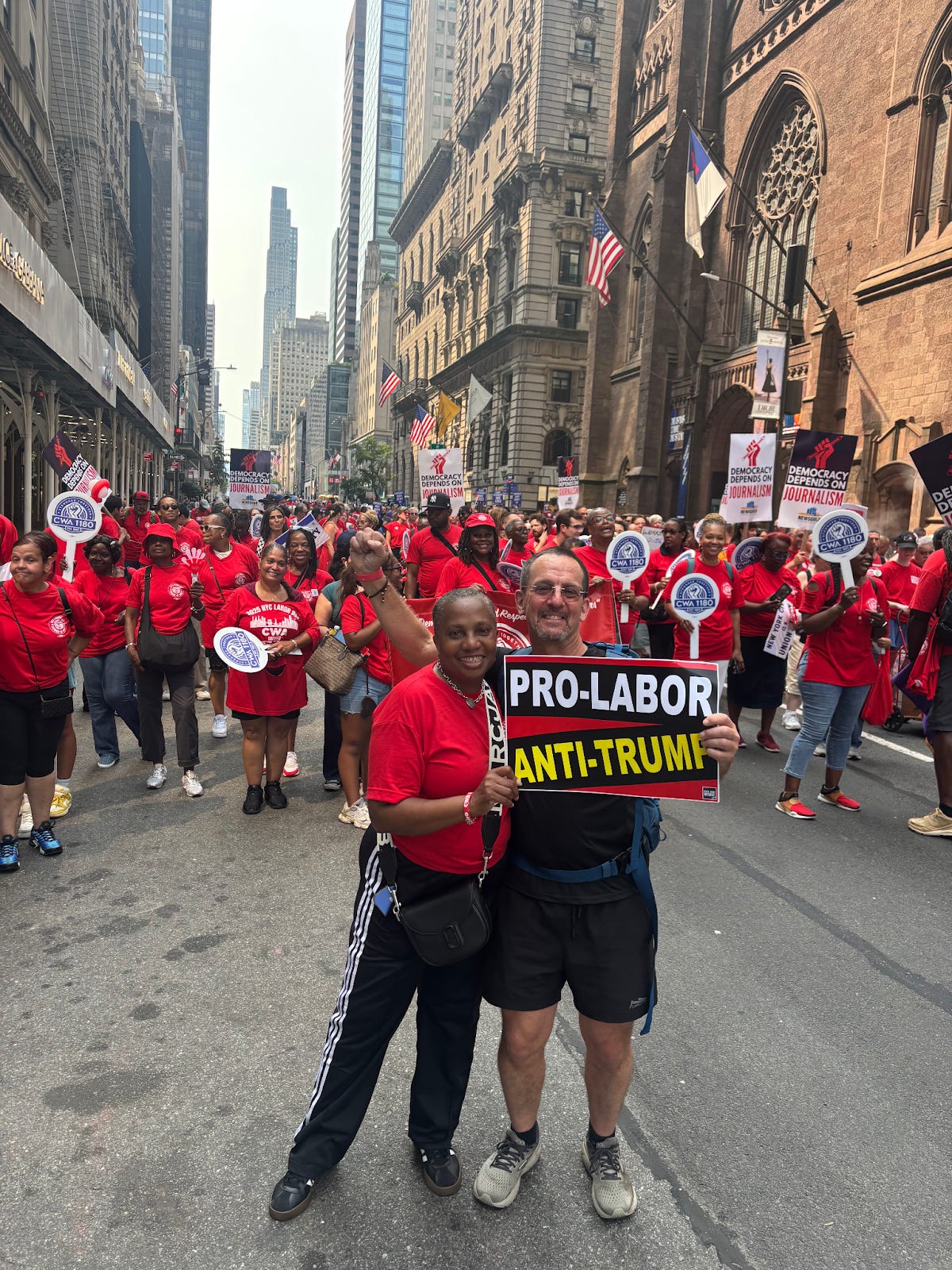
“Get up, get down, New York is a Union Town,” chanted different divisions of Union members. Teachers. Nurses. Stage hands. Journalists. The NYPD. The Fire department.
Floats. Music. Children.
Dogs.
Marching bands.
Defiance.
Dignity.
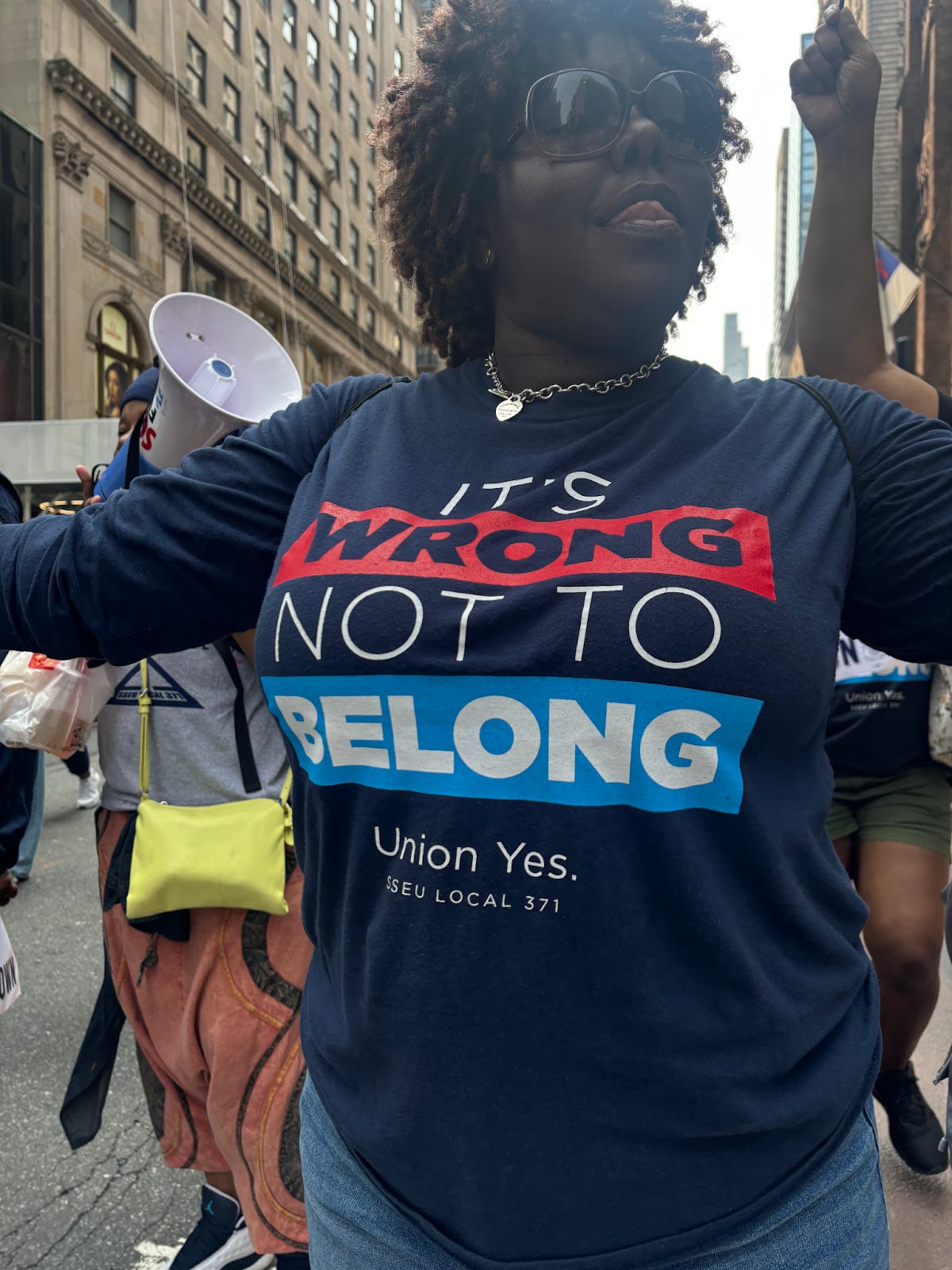
The march passed the infamous Trump Tower. Some stopped and mocked. Kendrick’s “They Not Like Us” blared out. Most just ignored it. Ostentatious and shiny, it couldn’t compare with real life on the street.
The sense of solidarity was overpowering. Joy in community. All different, but all united.
Miles away at the front of the march were Zohran Mamdani and Bernie Sanders.
As I watched, I felt deep down that Trump can’t win his battle against America.
He can war, but he can’t win.
He can scramble but he can’t unscramble.
The people want peace and freedom and when they realise just how seriously it’s threatened they will respond.
The problem is not the lack of resistance. It’s the lack of brave leadership.
Before I had left for the USA, a friend of mine told me she won’t visit “Trump’s America.” I beg to differ. It’s not Trump’s America. He’s just hijacked it. The Labour Day parade (more photos here) proved my point.
Read my story of my nine hours in New York here.
Human rights don’t live here anymore
“All human beings are born free and equal in dignity and rights” proclaim the opening words of the Universal Declaration of Human Rights.
In his 2020 novel, Another Now, Dispatches from an Alternative Present, Greek activist and economist Yanis Varoufakis, juxtaposed these words with a reality check:
“All babies are born naked. Soon afterwards, however, some are dressed in expensive clothes and put on a path to a privileged life while the majority wear rags and must perform miracles to escape from a life of exhaustion, exploitation, servitude and fear. This is the type of inequality that defines Our Now from cradle to grave.”
The danger today is that the oligarchs are waging a war to make ‘Our Now’ the natural and permanent order of things.
Read this important analysis by Adam Tooze: Chartbook 408: After the Last Utopia: China, the US, sustainable development and Hayek's bastards.
Human rights are under attack.
Everywhere.
Under attack: The idea of a world where international law is constructed around human rights.
Under attack: Three hundred years of steely advocacy to build that world.
I’m worried.
Activists are fighting back. Everywhere. All the time. But my question is: are we doing enough to persuade people that a world order that protects human rights to equality, dignity and freedom in law is better than a rightsless world?
I think not.
Otherwise why would millions be voting against equal rights?
The human rights ‘community’, particularly the lawyers, academics and NGOs that fight for human rights, must do much more to actively engage with social movements, and persuade them of the benefits of structuring the world we desire around human rights.
It shocks me how little value appears to be attached to the potential power of human rights systems to advance socio-economic rights by new thinkers, especially by writers who are sketching out alternative economic systems, like Kate Raworth (Doughnut Economics), Ingrid Robeyns (Limitarianism) or Varoufakis himself.
Engage! Show them the architecture that has been steadily built to advance human rights in the UN Human Rights system; the change it has yielded; remind people how in the 1960s the striving for a human rights-based order came from the South, particularly from countries like Jamaica (ever wondered why Bob wrote Get Up, Stand Up?).
Engage! recount the multitude of progressive changes that have come about because of an order built on human rights.
We need a rights-plus world, not a rights-less world.
We need the baseline of the UDHR, rather than the Code of Capital.
Rather pro-poor Constitutions than crack-up capitalism.
Don’t throw the baby of human rights out with the bloody bathwater of neo-liberalism.
Activists bookshelf: Genocide, Chile and the Chagos islands - the necessity for international law
In 2022 I was a writer in The Revolution Will not be Litigated, a fabulous collection of essays penned by lawyers who are activists and activists who use the law.
Its inspiring stories demonstrate how legal frameworks can be used or created to advance social justice. Social mobilization is indispensable.
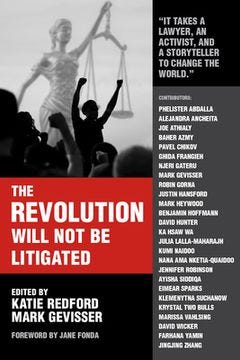
You can read the essays here.
But knowing human rights law and what it is capable of is important.
Enter Philippe Sands - a writer I recommend you read.
In his 2005 book Lawless World, Sands revealed how the beginning of the unravelling of international law started when, under a Labour government, British PM Tony Blair, ignored legal advice and supported the US invasion of Iraq.
Doing so opened a Pandora’s box that has made it easier for Putin, Netanyahu, Bolsonaro, Orban, Modi and now Trump.
Today another Labour leader, PM Keir Starmer, is up to it again.
Read: Starmer v Starmer: why is the former human rights lawyer so cautious about defending human rights?
Maybe we need a book about what happens to human rights lawyers when they gain power?
But let’s stick with Sands, a great legal historian whose books bring to life the people and struggles behind crucial human rights treaties, such as the Genocide Convention, the recognition of Crimes Against Humanity (read East West Street) and the struggle to free the Chagos Islands from British colonialism (read The Last Colony) .
Sands’ latest book, 38 Londres Street, is about the arrest of Chilean dictator Augusto Pinochet in London in 1998 for genocide.
You need to know these stories.
Human rights law will only work for us if we understand its history and then use it!
Artists unusual: Poetry in a time of Genocide
Across the world, a growing number of artists are singing-up their rights to freedom of expression, particularly to signal solidarity with the people of Palestine.
Kneecap and Bob Vylan grabbed the headlines earlier this year.
Now they’ve been joined by British singer, Billy Bragg, one of the voices of resistance under Margaret Thatcher. In the 1980s he wrote beautiful ballads like ‘Which side are you on?’ and ‘There is power in a Union’.
To support the Global Sumud Flotilla Bragg has just released Hundred Year Hunger, with the refrain “existence is resistance”,
And the legendary Neil Young has just released Big Crime, an anti-Trump song:
Don’t need no fascist rules
Don't want no fascist schools
Don’t want soldiers walking on our streets
Got big crime in DC at the White House
I love Sally Rooney’s novels.
A few weeks before 900 people were arrested in London for acts of civil disobedience (exercising their rights to freedom of expression), Rooney, wrote an op-ed titled I support Palestine Action. If this makes me a ‘supporter of terror’ under UK law, so be it.
Read: Literature as empathy: A call for stories that bridge divides, ignite understanding
Imagination refuses reality
A few years ago I celebrated the fusion of poetry and activism in a love letter to social justice activists.
Read: It’s Time to Riot: Putting Poetry back into Activism.
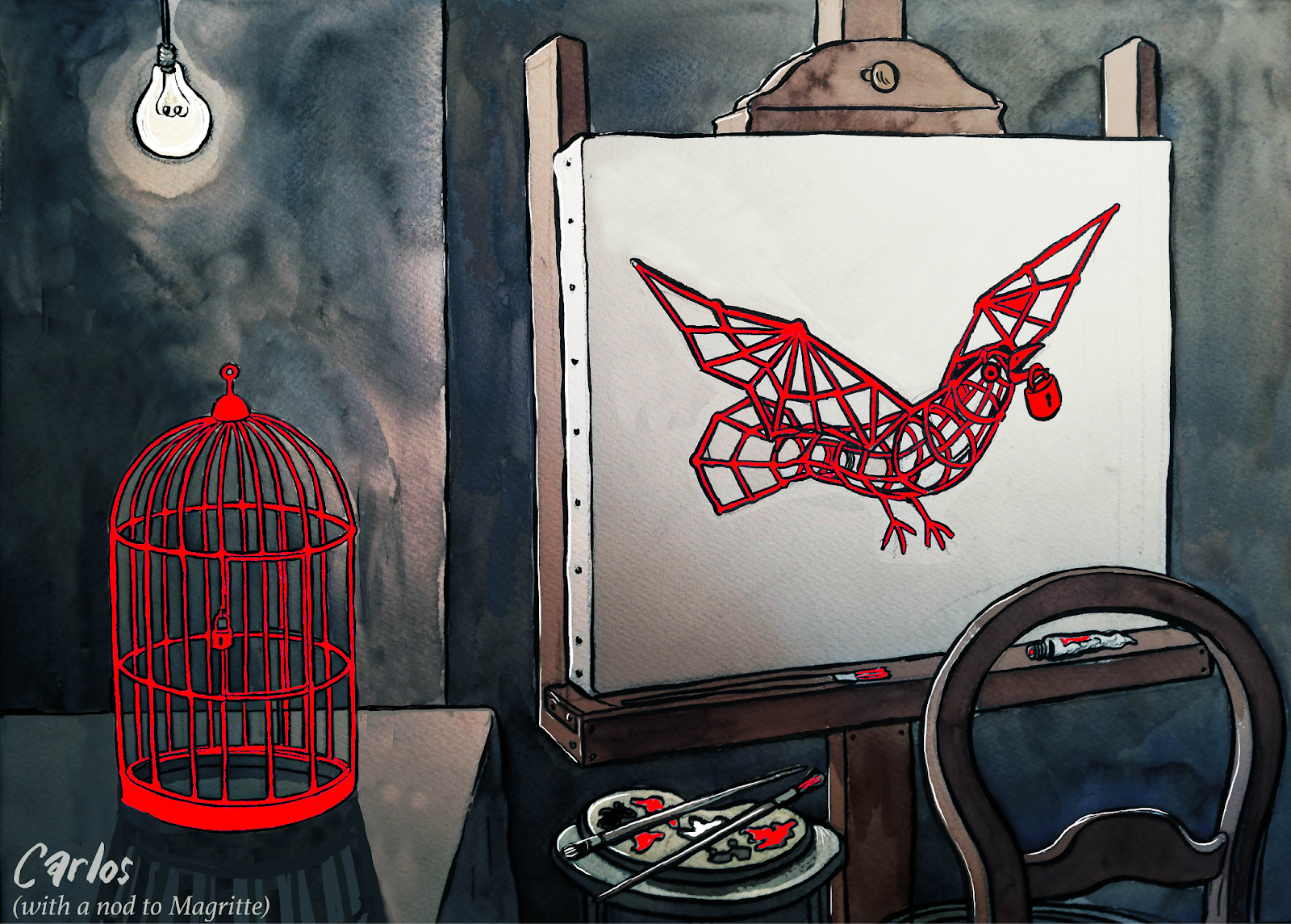
South African cartoonist Carlos Amato created “Uncage”, the cartoon above,” to illustrate my article.
Great political cartoons never die, so I asked Carlos to explain his “nod to Magritte” for those less versed in art history (me!).
With the caveat that he doesn't normally title or explain his cartoons Carlos replied that it’s “a 2020 tweak on Rene Magritte’s series of paintings called The Human Condition, in which a landscape canvas on an easel merges with the source scene behind it.”
“Magritte was concerned with the indivisibility of perception and reality between painter and subject. This update is about a more interventionist / rejectionist creativity; in which the imagination refuses reality in order to remake it.”
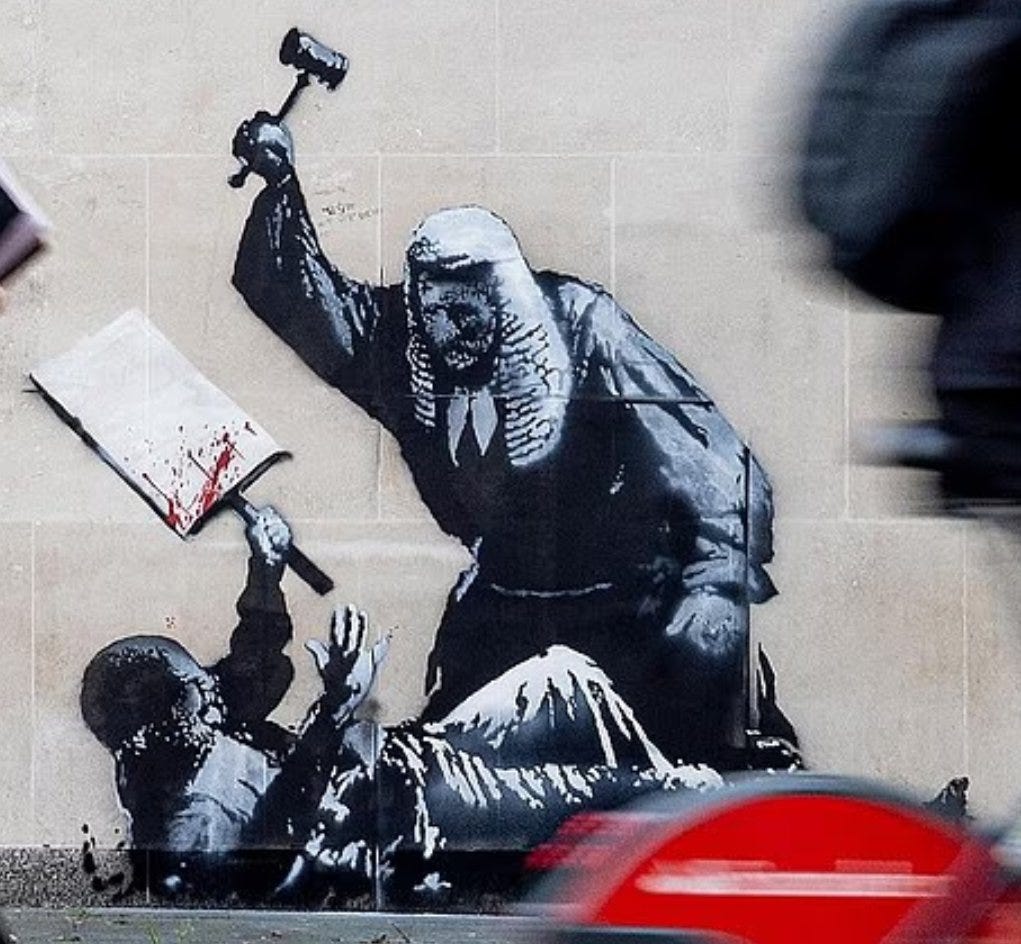
Talking about art: Banksy’s take on the prohibition of freedom of expression in England (opposite) was left on the walls of the Royal Courts of Justice in London - and quickly washed away.
However. As much as some artists are speaking out, I wonder about the silence of some of my favourite writers and singers.
Bob Dylan, where art thou?
You were right to damn the masters of war but your silence on the genocide being carried out by the “neighbourhood bully” emasculates your reputation as a freedom singer.
Now is not the time for silence.
Imagine
When I’m in New York I always visit Strawberry Fields, the memorial Yoko Ono created for John Lennon, in Central Park. It’s opposite Dakota Mansions, their home where John was assassinated in December 1980.
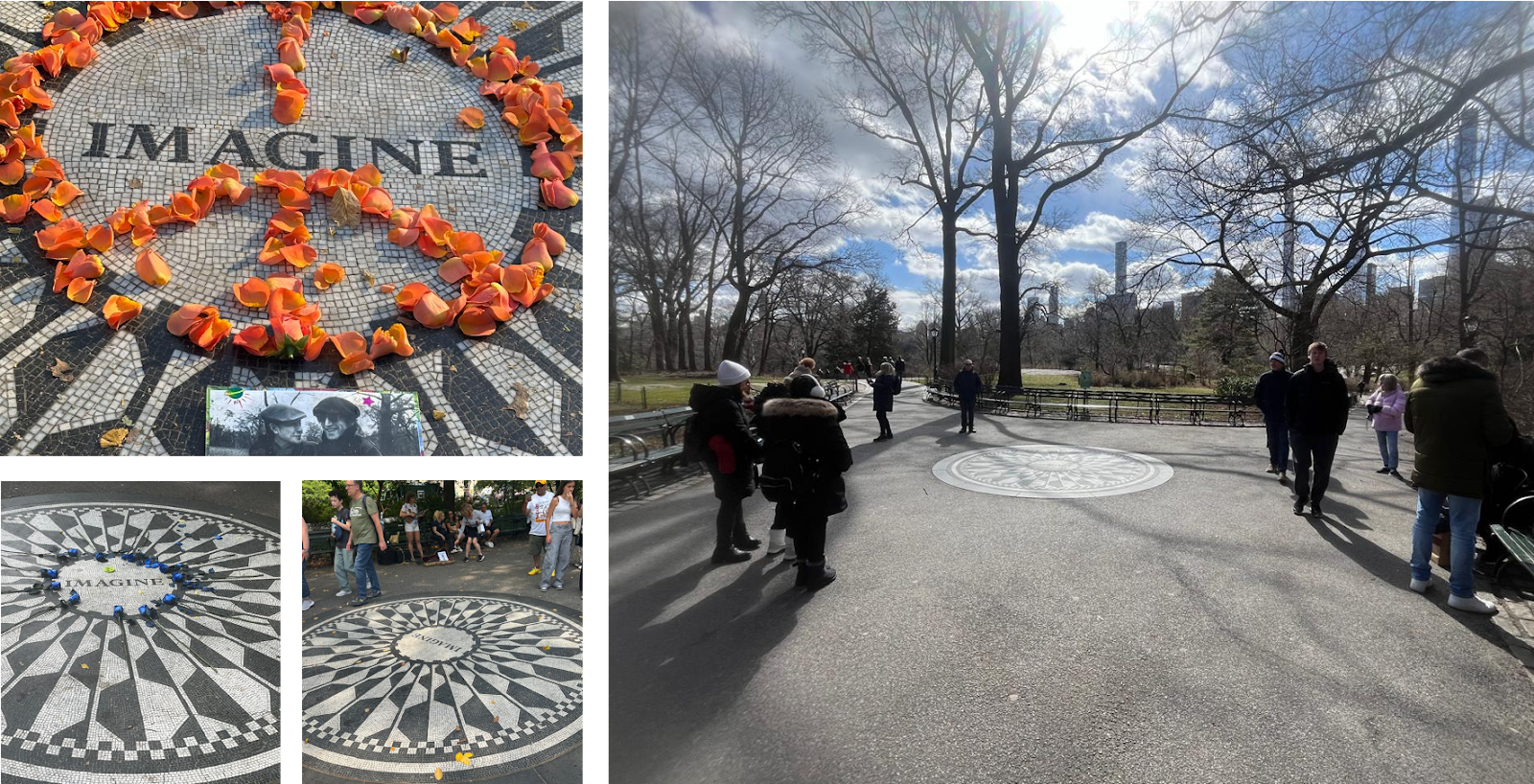
Changing/Unchanging: Images from Strawberry Fields
Strawberry Fields is like the concourse of Grand Central Station. A never-ending river of people runs through it, pausing, pondering, kow-towing before the Imagine mural. A single busker is always there to sing Lennon’s songs. This time it was Liz Chidester singing mostly love songs.
I sat there people-watching for an hour until Liz finished with the poignant Golden Slumbers (a Lennon and McCartney song):
“Once there was a way to get back home again … sleep pretty darling, do not cry and I will sing a lullaby.”
But I did feel like crying.
Being maladjusted to inhumanity. “Refusing reality in order to remake it ...” isn't that what all social justice and human rights activists are trying to do? Don’t give up.
Until next time.
Love and peace,
Mark
Heywood
If you enjoyed this newsletter please forward it to other soul rebels. They can subscribe by contacting me at markjamesheywood@gmail.com
News from JAH is also now available here on Substack!
The Justice and Activism Hub is a change tank for a time of change. We are committed to strengthening social justice struggles through connection, collaboration, coordination, convening and catalysing.