
Love to see when ya move in the rhythm
I love to see, when you’re dancin’ from within!
It gives great joy to feel such sweet togetherness
Everyone doin’ and they’re doing their best
Bob Marley, Jump Nyabinghi, Confrontation, 1983.
Soul Rebels,
Bike riding and social justice seem unlikely bedfellows. But bedfellows they can be.
In 1821 English activist William Cobbett (a complex character if ever there was one) got on his horse and rode through rural areas in England to witness and describe the poverty caused by Corn Laws and industrialisation (the bicycle would only be invented a few years later). 200 years later his book, Rural Rides, rings through time.
At the start of the twentieth century bikes were a cog in the the women’s movement in the USA and Europe.
On the other side of the world, in 1913, journalist and ANC activist Sol Plaatje travelled parts of the Orange Free State (as it was then) on a bicycle documenting the impact of the 1913 Natives Land Act. His book, Native Life in South Africa, is still a classic 113 years later.
So many years. So many changes.
So little change. Poverty still bleeds.
Bike riding is something I would highly recommend for politicians. Pedal power gives you a proximity to a community that doesn’t come in expensive sedans.
But bikes don’t have blue lights.
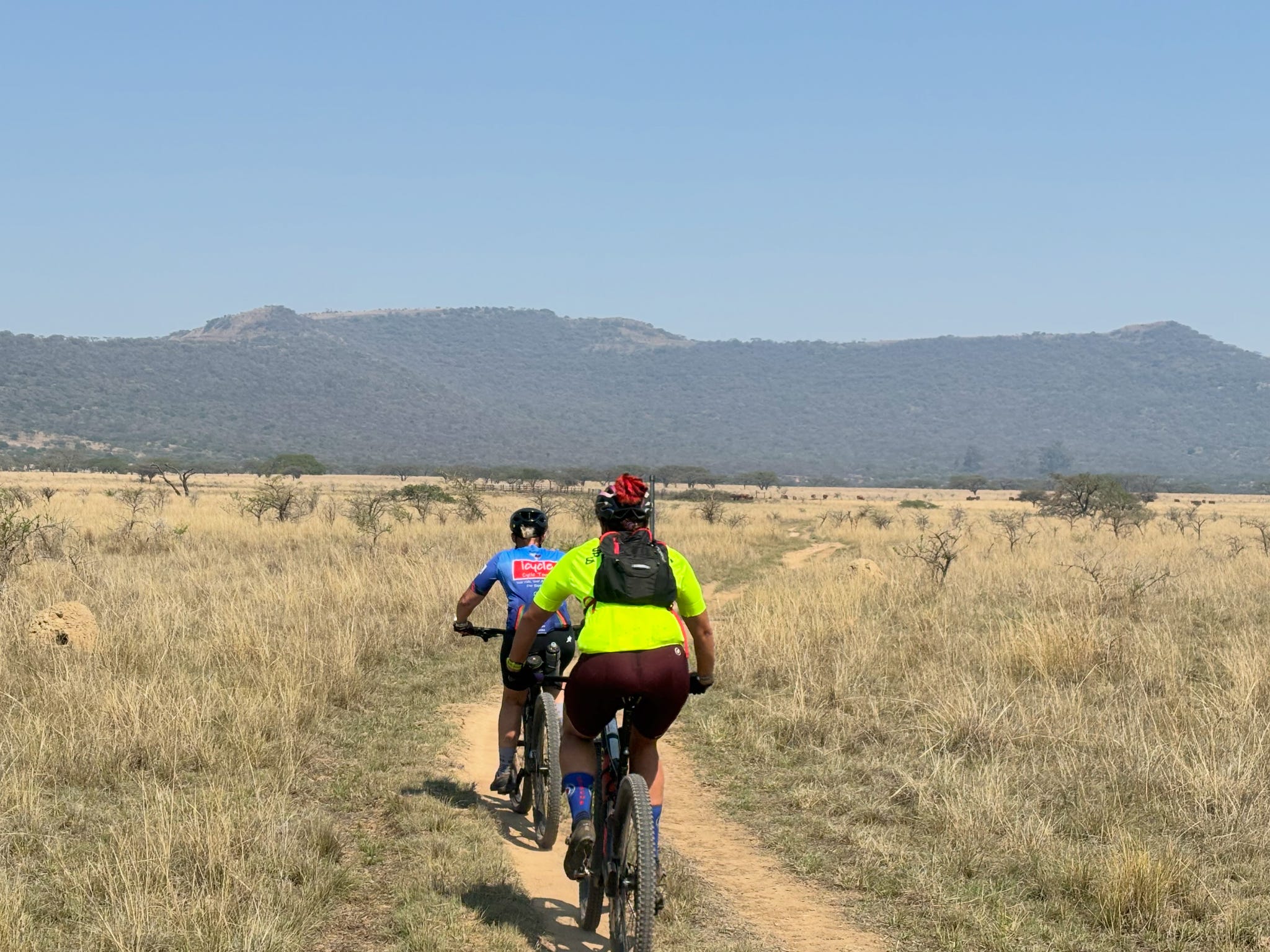
Earlier this month I used the opportunity of a wonderful 600km mountain bike race from Clarens, on the edge of the Maloti/Drakensberg Mountains to Ballito on the Indian Ocean to do the same.
Read more about my ride: Child hunger drives bid to raise R1-million on 650km cycle ride and Halfway Mark: Heywood on the R1m child hunger drive on a 650km bike ride
Over seven days of riding what struck me was
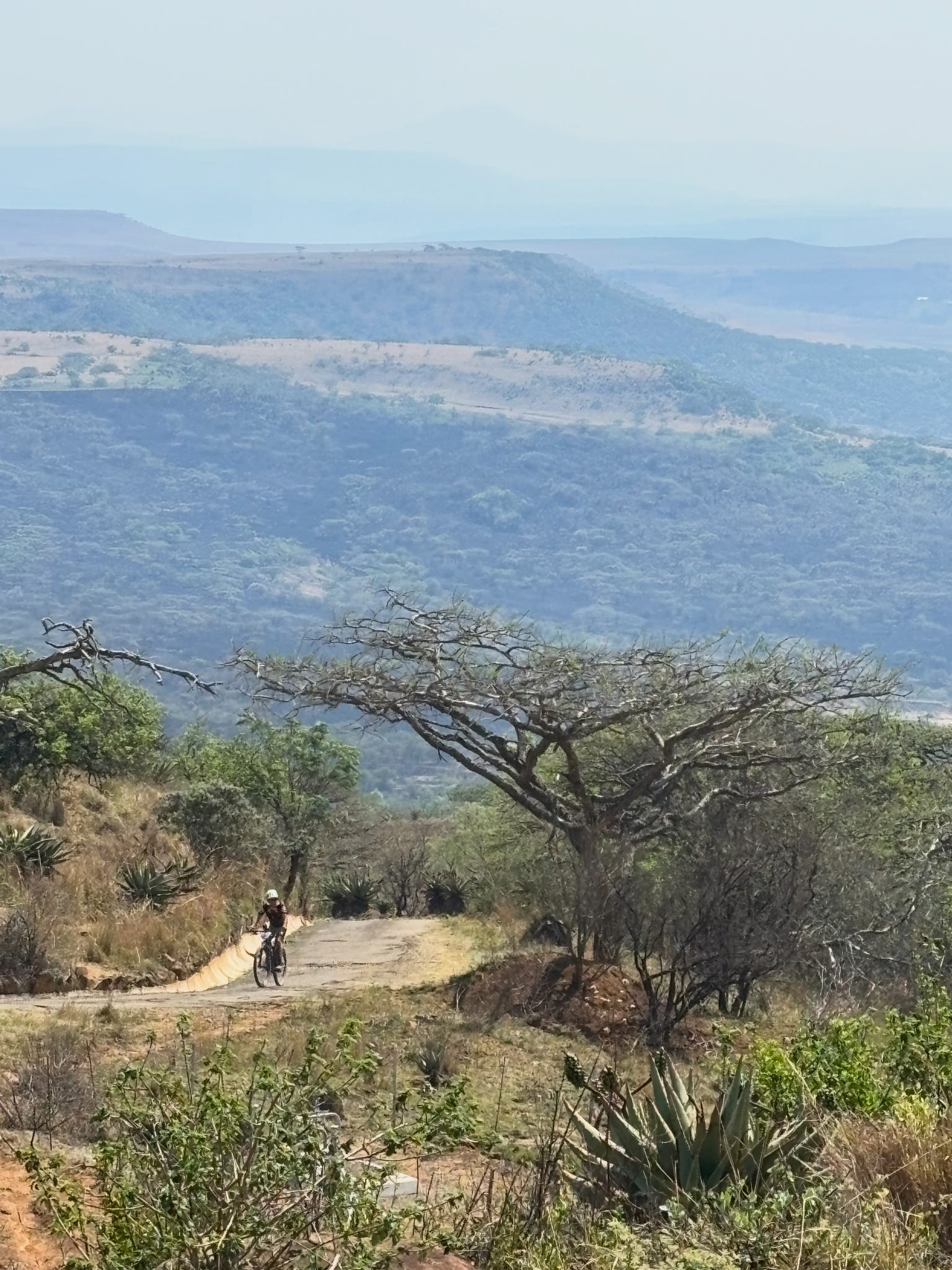
The majesty (of natural beauty) and the misery (of poverty).
The splendors and the silences.
The beauty and the beastliness.
The smallness of humanity against the largeness and largesse of nature.
I make no bones. I rode to find joy and peace. To quash the ache in my soul. The water points, and each day’s finishing line, were served by primary school children. Their laughter and dance, innocence and egalitarianism towards each other, was the fuel my imagination needed.
I used my privilege to raise awareness about hunger and malnutrition and to try and raise money for the Union Against Hunger.
You can still donate here.
One of the biggest lessons I learnt was human. Each day, I rudged (that’s a word I invented: riding for trudged!) over the finishing line amongst the last 20 riders.
By contrast a friend of mine, Siyabonga Ntsele, a young man from Soweto, won two of the seven stages. He was duelling with SA’s top mountain bike riders. Siya does not own his own bicycle. He was on a borrowed bike. He was competing against the most privileged.
It made me understand, again, how much human skill and joy will be released when we overcome poverty and inequality.
Thumbs down: Blistering barnacles (literally)!
But in the quest for social justice we have to act fast. And smart.
The carbon chickens are home to roost on this fragile nest we call earth. And life – and resistance – is getting harder.
A new UN report says the world will overshoot the 1.5°C climate target.
It’s calculated that the ‘Godzilla’ El Nino phenomena, now supercharged by a hotter planet, will cost 450,000 lives by February 2027.
Read the report: Limiting Overshoot: Navigating exceedance of 1.5°C and pathways towards return
Thumbs up: Vive la resistance!
My last issue of News from JAH celebrated the liberatory power of music.
One evening, after a long day on the saddle, from the comfort of my tent, I read about Ed Sheeran’s removal of Macklemore for uttering “Free Palestine”, and the scale of the reaction in protest. Macklemore and other musicians have now announced a Free Palestine tour in several European cities. Reaction and counter-action.
Listen to Macklemore’s Hinds Hall
As Pink Floyd’s Roger Waters wrote so many years ago in his wonderful song, The Tide is Turning, there are green shoots of a new resistance everywhere. It’s mostly led by the people who have the most to lose, the young.
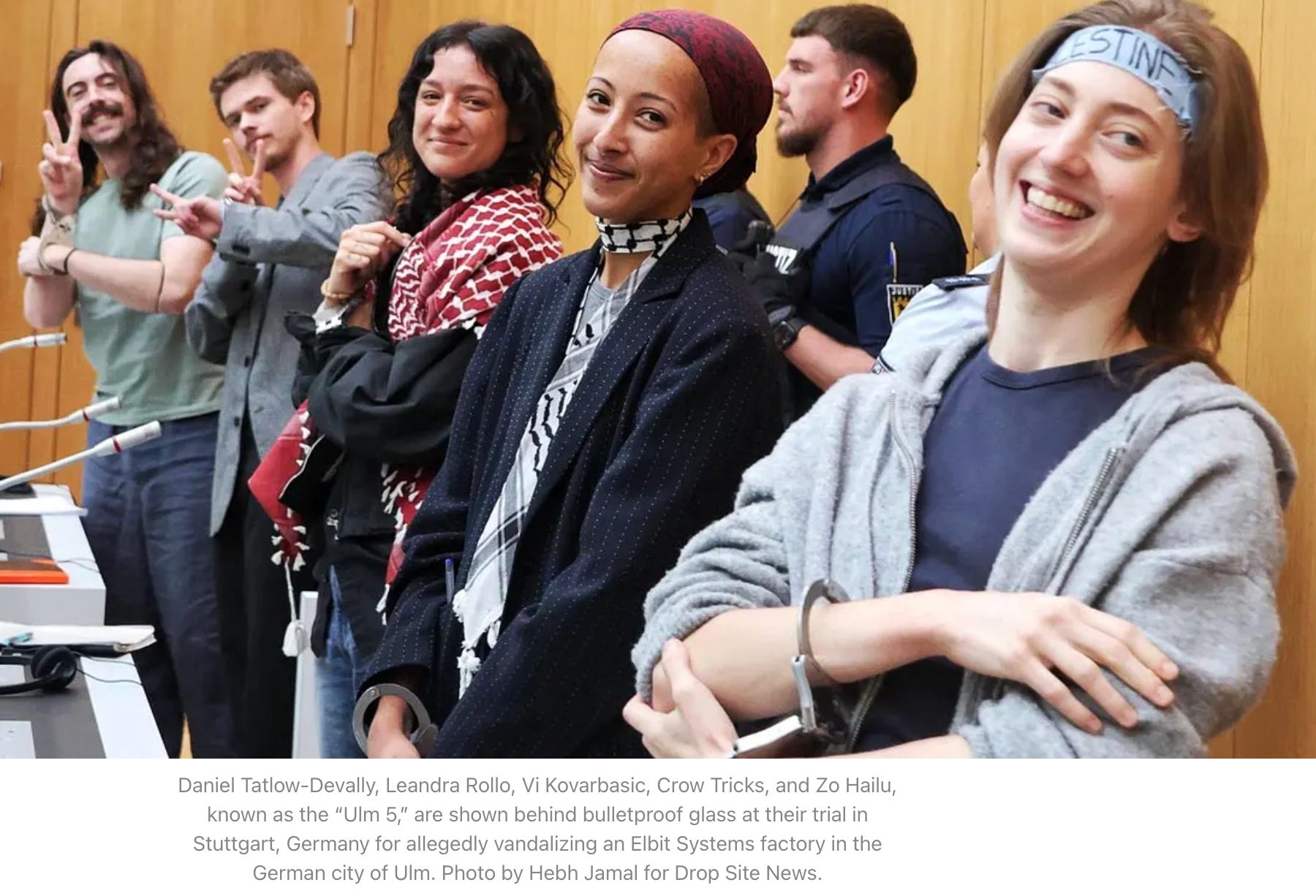
Witness the trial of the Ulm Five in Germany, and the young prisoners’ open defiance of the authorities despite the threat of long sentences.
Submit or fight? These are the young Mandelas of our time. They know where justice lies. Like Mandela, they know that the end-times are a time for laying your life on the line.
Activists bookshelf: Blooming podcasts
Friends, activists, organisers, lend me your ears!
South African activists are producing podcasts that offer great insights into our politics. They speak to the richness, diversity and ingenuity of our tribe of world-changers.
Here are a few to get familiar with:
This Way Upp, put together by Babette Gallard and Terry Shakinovsky, is a podcast that interviews activists the ordinary media overlooks. You can find it on YouTube here.
Noncedo Madubedube, former General-Secretary of the learner organisation Equal Education, has started a podcast. Check Noncedo’s website or tune in here: Mabaphil’ABANTU.
My Vote Counts is also in on the act, with popEd and an inaugural interview with Nomzamo Zondi, one of our best activists.
Sizwe Mpofu Walsh continues to be the go-to place to hear thoughtful conversations with many of the people who shape our politics and government. But Sizwe is now joined by another astute activist, Dr Mbuyiseni Ndlozi, whose African Renaissance podcast is supported by the Thabo Mbeki Foundation. In this context, I’d highly recommend Ndlozi’s interview with Achille Mbembe Why Africa is Still Not Free After 70 Years.
Then there’s Politically Aweh, our equivalent of Jon Stewart’s fantastic Daily Show, but without as much money behind them;
Finally, the Institute for Economic Justice (IEJ) has done an essential and informative series on economics for activists.
Activists departed: On death
The great feminist writer and activist Gloria Steinem has left this world’s stage at the ripe age of 92. Mission accomplished.
On the other hand the loss of Dr Prinitha Pillay, a caring, committed health activist and hands-on doctor, comes far too soon. Humanity and our quest for health has been deprived of a shining light.
It perturbs me how quickly we, the living, move on from death, and how little deep contemplation loss leads to about life and/or a life. In these frantic days, there’s no pause.
When I was young and inexperienced in dying I always imagined that death would be marked in the way Shakespeare’s Othello laments the death of Desdemona:
Methinks it should be now a huge eclipse
Of sun and moon, and that th’ affrighted globe
Should yawn at alteration.
But that’s not the way we roll. Too much shit on our minds. The tide quickly washes over the material marks we made with our lives. But these two women made indelible imprints on our souls. Hamba kahle, UmKhonto.
Africa Arise
In the midst of the hot wars, hyper-politics and crack up capitalism we might be forgiven for thinking that Africa has been erased from the world.
Don’t fall into that trap. It hasn’t.
In the epigraph to Rethinking Activism in Africa, now published and on the shelves, I placed a quote from historian Achille Mbembe, situating Africa in the current turmoil.
Achille says of Africa:
“We are the oldest continent, and the youngest.
We are a reserve of power and a power in reserve, both at the same time.
Because of our capacity for resilience over centuries, there must be something in our deep archive which speaks to some of the key challenges of our time. Therefore, it becomes absolutely important to engineer the African moment – in the humanities, in the social sciences, in modes of organisation of life.”
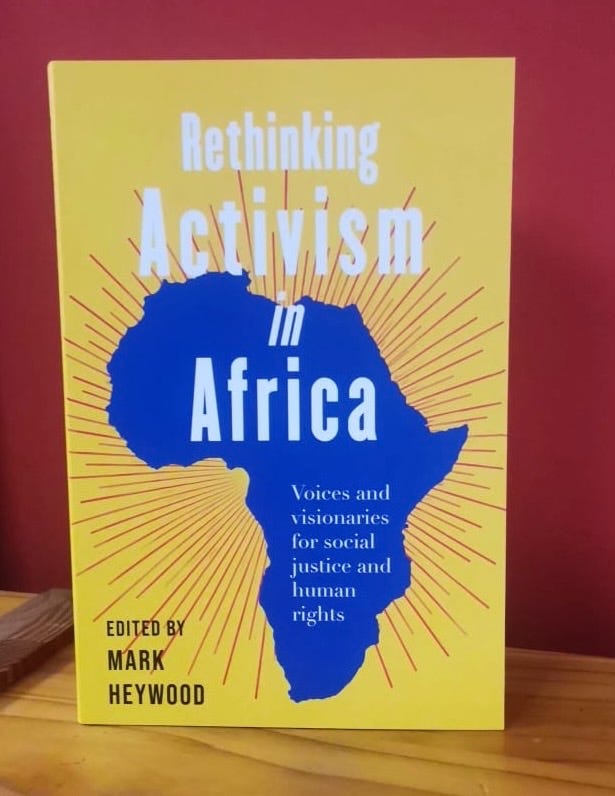
Activists as engineers! Absolutely. But to be successful engineers we must pay more attention to our Africa. We must stop being dazzled by the antics of far-away clowns bearing bombs and AI brides.
September is the month when we recall the murder of Steve Biko, almost 50 years ago. In this time of fracture and incitement Steve’s philosophy of Black Consciousness is as relevant as ever. It calls for an African consciousness that embraces awareness of and joy in:
Our music. Listen to Richard Nwamba’s weekly medley of Africa’s music on Radio 702.
The renaissance in our writing: How Cassava Republic Press changed the ownership model of African literature
Our land mass and geography: It only took 450 years for the world to adopt a geographically accurate map of Africa! UN votes to adopt new world map that shows Africa’s true scale
Our civic life and politics: Subscribe to an Africa-centric news service This Week in Africa
Our history and rights. Viva Jamaica’s decision to formally petition Britain’s King Charles for slavery reparations; and the King’s to refer the petition to the Privy Council.
Africa, our continent has been strangled, scrambled, battered, brutalised, belittled, but it refuses to lie down. As Bob wrote in his beautiful song Black Survival, “We’re the survivors …”
According to Achille, we may ultimately be the saviors too.
Don’t give up. We have a world to win.
Love and Peace,

Mark
Heywood
This newsletter aims to be a resource as much as a read. Follow the links. Listen to the musical accompaniment. Written and researched by a human being. No AI agent involved.
The Justice and Activism Hub is a change tank for a time of change. We are committed to strengthening social justice struggles through connection, collaboration, coordination, convening and catalysing.
News from JAH is available here on Substack. The playlist of songs that I feature is available here. If you enjoyed this newsletter please forward it to other soul rebels. You can also contact me at markjamesheywood@gmail.com