

So Jah seh, yeah
“Not one of my seeds
Shall sit in the sidewalks
And beg your bread”
No, they can’t and you know that they won’t
Bob Marley, So Jah S’eh, Natty Dread (1974)
Soul Rebels,
Humans have gone gaga about the moon again. And for good reason. Artemis II represents the best side of science and human endeavor.
It puts us accidental humans back in perspective.
Or it should.
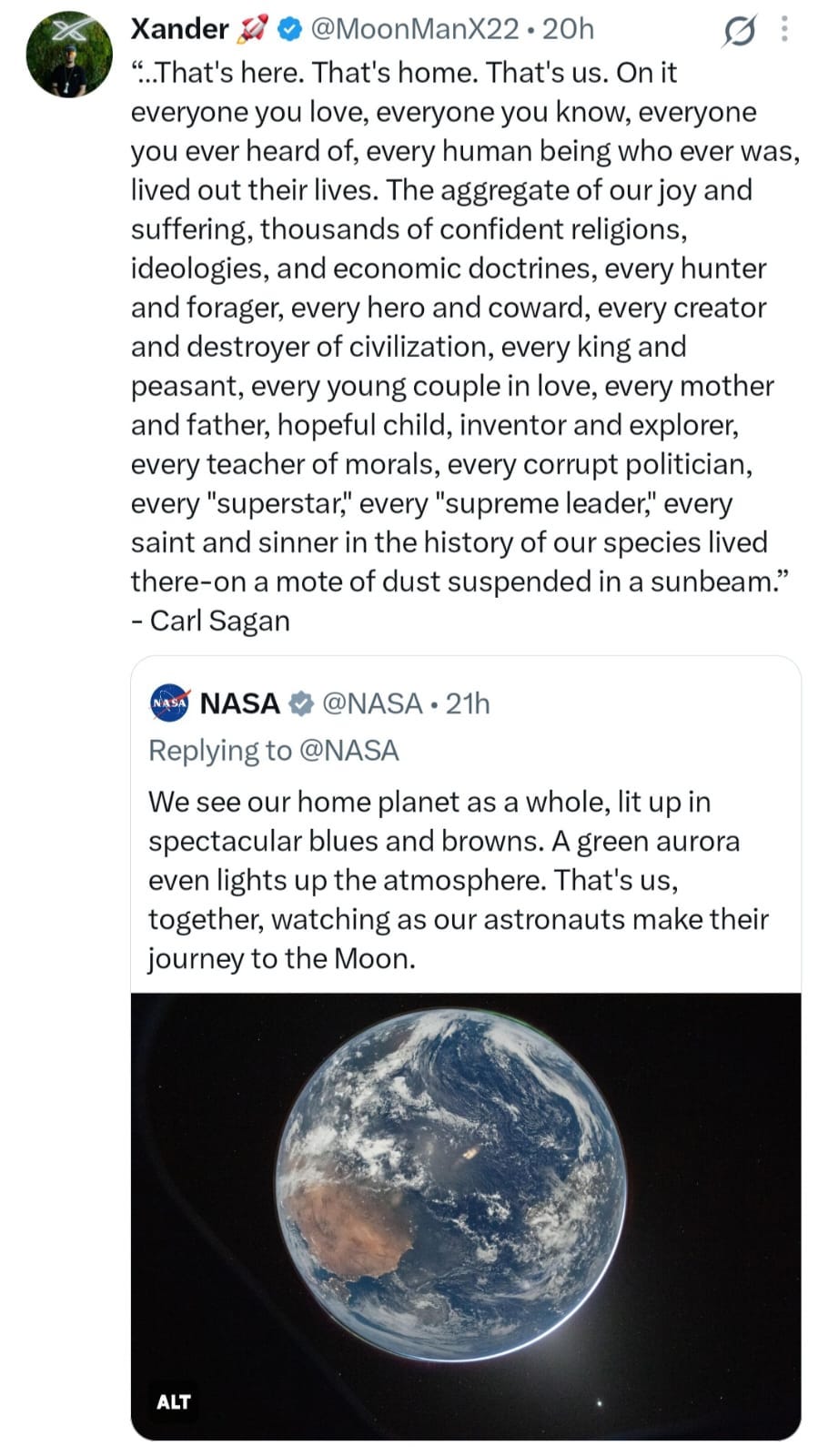
Artemis’s 10-day trip around the dark side of the moon also coincided with the 58th anniversary of the murder of Martin Luther King. MLK too had something to say about space travel. In his Nobel Peace Prize lecture in 1964 he juxtaposed the progress of science with the regress of equality.
“The richer we have become materially, the poorer we have become morally and spiritually. We have learned to fly the air like birds and swim the sea like fish, but we have not learned the simple art of living together as brothers.”
What’s new?
In a 1967 speech, MLK had confessed to suffering from “maladjustment”, a term that in those days was a shoddy euphemism for the mentally ill.
Listen:MLK: Creative Maladjustment (UCLA, 1965; Courtesy of UCLA Communications Studies Department) (from 42.52 mins)
But MLK turned maladjustment on its head. He declared there were “some things within our world and our nation of which I’m proud to be maladjusted”.
He was maladjusted to inequality and injustice.
In the context of the growing militarisation of the Cold War, he called for the creation of an “International Association for the Advancement of Creative Maladjustment”.
The Justice and Activism Hub (JAH) is a home for the maladjusted.
News from JAH is a newsletter for the maladjusted.
This issue celebrates the creatively maladjusted.
The dialectic of darkness
Rebecca Solnit has been maladjusted for years. In her 2005 book, Hope in the Dark, she writes: “The future is dark, with a darkness as much of the womb as the grave.”
Activism is the dark womb of a better world.
Hope in the Dark, republished with a new Foreword in 2015, is her paean to activism. It’s a reminder that, much as the world seems dark today, activism has successfully pushed frontiers.
And must continue to push.
Solnit has a new book: The Beginning Comes After the End: Notes on a World of Change. In an interview with the Guardian on the ‘slow revolution’ the far right cannot tolerate, she continues the birth metaphor:
“A new world is being born, and they’re basically trying to abort it. Which is a little ironic, given their views on abortion.”
Read Rebecca’s newsletter: Meditations in an Emergency
The world progressives must abort

Don’t pretend you are not frightened. A deranged, narcissistic, sociopath rules the White House. A murder of sycophants – the Epstein class – work to enable his abuses. Nazis in suits.
Three hundred+ million people are hungry worldwide. Nearly 100 million Americans cannot afford quality health care. But, as the website of the Cost of War project reveals, when it comes to war money is irrelevant.
This article in the Guardian, breaking the cost down in charts says it all.
But it gets even more depraved. In the casino economy, insider trading has now spread to betting on war and politics.
Read: How Anonymous Bettors Cashed In on the Iran Strike, Just Hours Before It Happened;
‘Abhorrent’: the inside story of the Polymarket gamblers betting millions on war ;
The insider trading suspicions looming over Trump’s presidency
Reasons to be cheerful, part 19
But hang on in there, as the late, great Ian Dury sang, there are many reasons to be cheerful:
The plan to charge Qedani Mahlangu, the politician who ordered the relocation of mental health care users at Life Esidimeni leading to 144 deaths, with culpable homicide is a victory for civil society tenacity: NPA finally pursues justice for Life Esidimeni victims after nine years of delays
The defeat of Victor Orban, another victory notched up for Gen Z who voted in record numbers against Orban.
The Short and Ridiculous Trial of a Protester Arrested in an Inflatable Penis Costume
Activist’s Bookshelf:
The Epstein class doesn’t give a shit about the human and environmental cost of war. But, do we? Inoculated to violence by TV, distracted by social media, can we feel the levels of pain being inflicted on people like us?
If we did, wouldn’t more people be out on the streets screaming STOP?
Read my 2025 article: People in pain: How long will you and I be silent?
Trying to feel others’ pain led me to Susan Sontag’s 2003 Regarding the Pain of Others (2003).
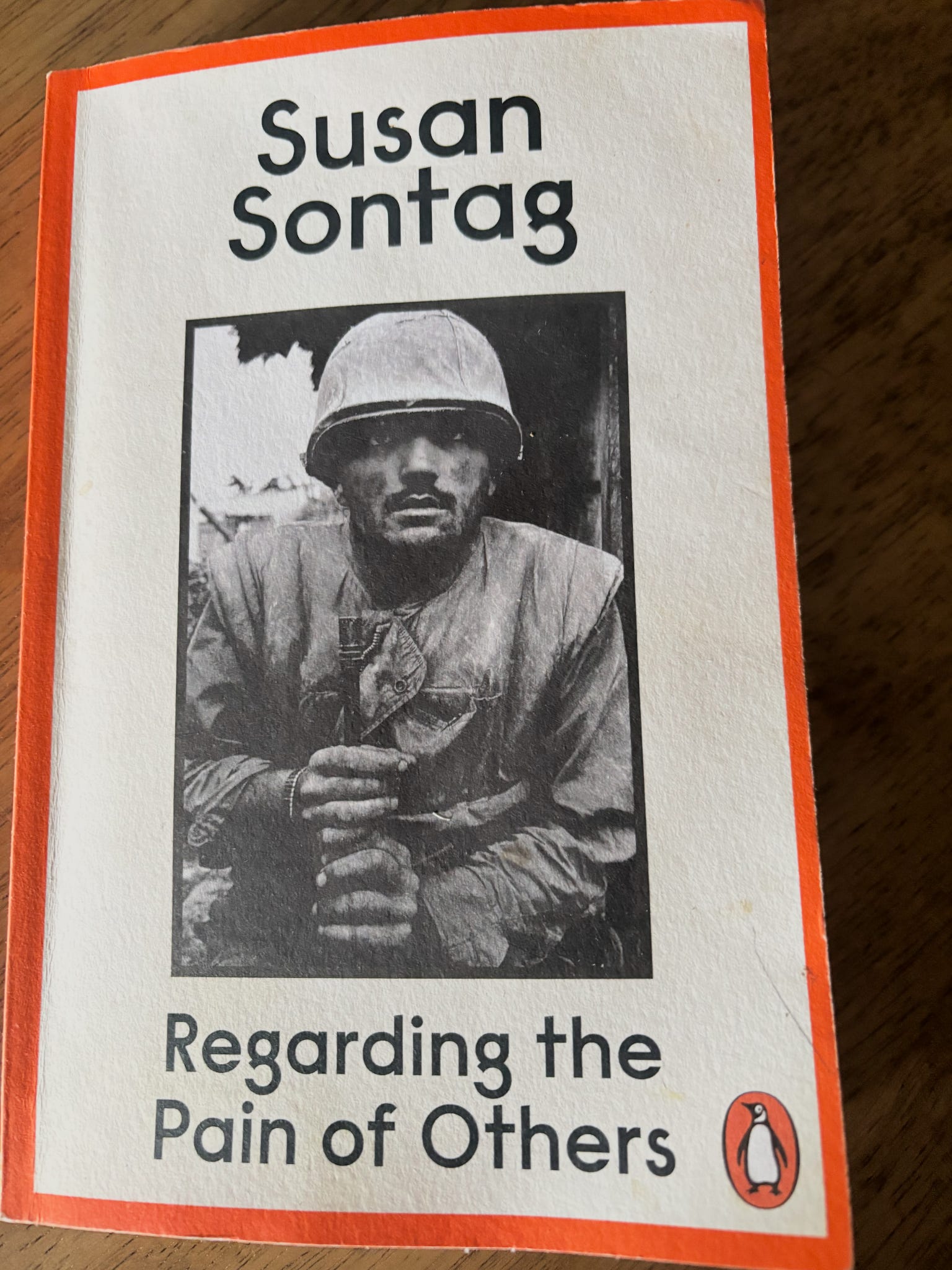
I recommend you read it too.
Ostensibly it is a little history of the landmarks of war photography. How paintings and then photography brought distant wars to our dining tables.
How, over a century, these photographs shocked – then numbed – then normalised – and then were co-opted and curated to disconnect us from the pain of others.
Sontag warns that “our culture of spectatorship” has paradoxically contributed to a “deadening of feeling.”
“There is still a reality that exists independent of the attempts to weaken its authority.”
Reading, especially women like Sontag and Solnit, is an exercise we should do to keep our souls alive. A step in reawakening and sustaining our own compassion.
But, warns Susan:
“Compassion is an unstable emotion. It needs to be translated into action, or it withers. The question is what to do with the feelings that have been aroused, the knowledge that has been communicated.”
That’s a question for you too, soul rebel.
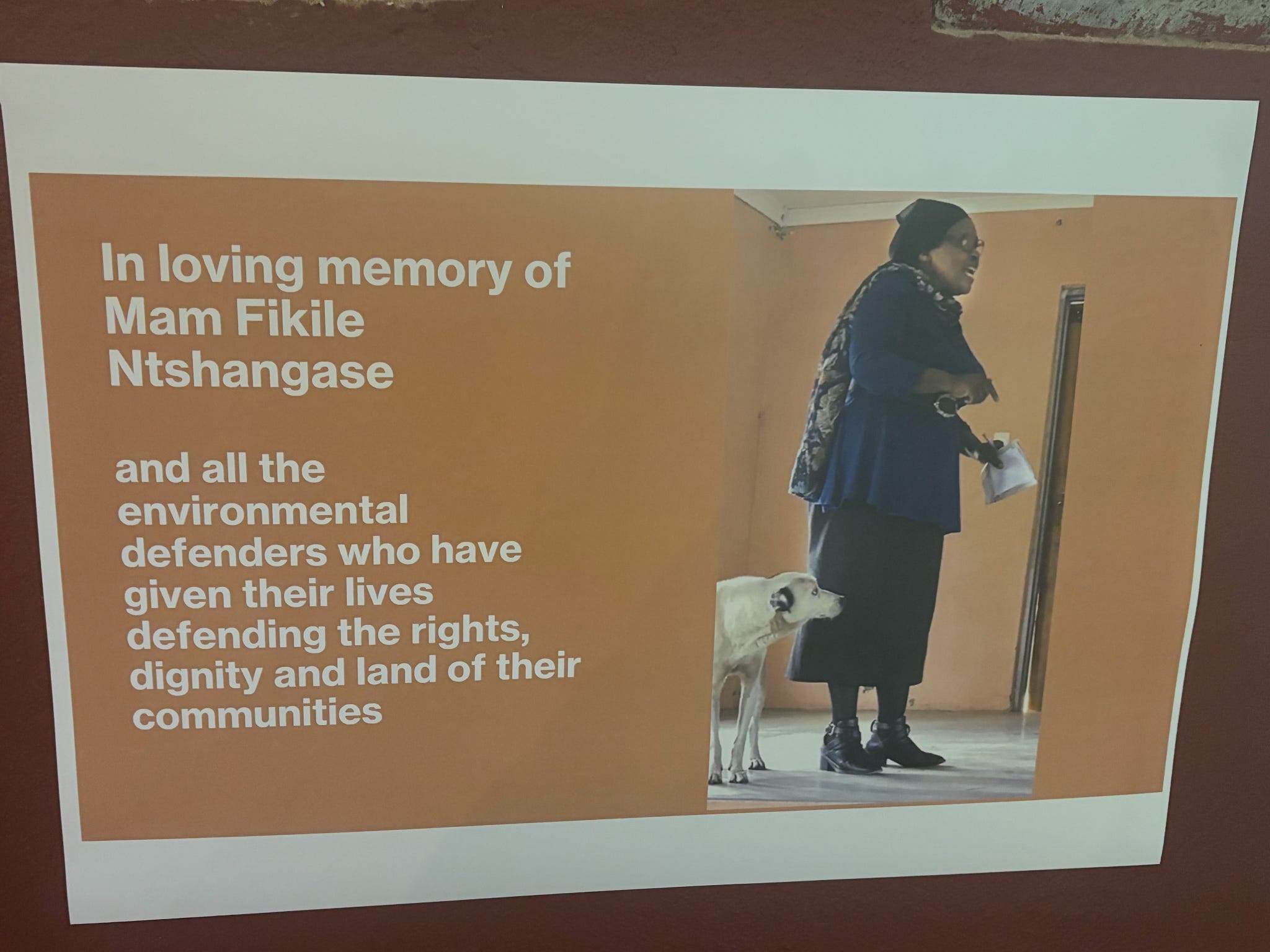
Artivism: In memory of Fikile Ntshangase
Theatre is an art form that can bring the maladjusted back to life.
Isitha Sabantu, the latest play produced by Empatheatre, premiered at Jo’burg’s Market Theatre in March 2026. It recreates the real-life conflict brought by a coal mining company to a rural village in KwaZulu Natal. The Somkhele community’s resistance, led by MaFikile Ntshangase, led to her assassination.
Read: New play honours murdered environmental activist Fikile Ntshangase
Fikile Ntshangase - Another Environmental Activist Violently Silenced
Police claim Fikile Ntshangase’s killers are dead, but who paid the hitmen?
South African’s capacity for innovation, imagination, acting and genre-bending never ceases to inspire me. For three hours Isitha Sabantu’s minimal set, use of puppetry, choral song, choreography, poetry tugged at my soul.
There is a scene that defies description. But let me try.
The stage is covered with a green tarpaulin, uneven to capture the rolling hills of KwaZuluNatal, dotted with traditional homesteads. As the play approaches its climax, the land collapses, the tarpaulin sucked into a vortex, disappearing into a hole in the centre of the stage.
This is the moment the Tendele coal mine succeeds in breaking community resistance.
Isitha Sabantu is on its way to Durban and Cape Town. Watch the teaser here.
Maladjusted: Rest in Power, Stephen Lewis

Stephen Lewis, politician, feminist, philanthropist, ACTIVIST, was maladjusted. He is a dear friend and a comrade to me and many other maladjusted persons.
Read: Stephen Lewis, Canadian politician and social activist, dies aged 88;
Farewell, Stephen Lewis, the man who shamed the world into seeing Africa’s Aids catastrophe
Some of the words that best capture the meaning of Stephen’s life and death come from Vuyiseka Dubula, one of the young women most instrumental in building and leading the Treatment Action Campaign (TAC):
“He walked with us in Africa, not ahead of us, not above us, but alongside us, in the struggle for equitable access to health, dignity, justice, and life.
He was an ethical leader who understood his privilege as a white male from Canada and chose, consistently and deliberately, to use it in the service of humanity.
He lived a full life, yes, his departure is not a gentle grief to our tender hearts.
His departure reminds me of the moment I met him at a time when the world was in a dark place of AIDS silence. Stephen spoke. When systems failed, he challenged them. He refused comfort when injustice demanded courage. He brought moral clarity into spaces that too often settled for indifference.
He used his position and his voice to lift others, especially women, girls living with HIV like me, grandmothers, and grassroots activists, recognising them not as beneficiaries, but as leaders.”
Read Vuyiseka’s full tribute here
Read Sipho Mthathi’s tribute here: Remembering Stephen Lewis means interrogating the world that made him necessary
Settings sons/suns
In 1979 The Jam, an English band led by Paul Weller, released Setting Sons, their fourth album.

Recently, while marveling at the cloud and light play, the wondrous world, as the sun set over the Ukuhlamba Drakensberg mountains, a song slipped from the album into my mind. I remembered Little Boy Soldiers, a song in which the musical accompaniment suddenly halts, and this haunting lyric follows:
Come on outside - I’ll sing you a lullaby
Or tell a tale of how goodness prevailed
We ruled the world, we killed and robbed
The fucking lot - but we don’t feel bad
It was done beneath the flag of democracy
You’ll believe and I do - yes I do, yes I do
Nearly fifty years later the sun still sets in a blaze; astronauts still marvel at the beauty of our planet from afar; writers wonder at our stupidity; and wars, poverty and disease still cut down people in the prime of life. Humans still wrestle with existential issues of love, fairness, peace, dignity which have been our preoccupation since we started to express ourselves in poetry. As old as Gilgamesh or the Bagavad Ghita.
But the times are getting more extreme.
We must all be activists now.
There is work to be done.
Love and Peace,

Mark
Heywood
Written and researched by a human being. No AI involved.

The Justice and Activism Hub is a change tank for a time of change. We are committed to strengthening social justice struggles through connection, collaboration, coordination, convening and catalysing.
News from JAH is also now available here on Substack. The playlist of songs that I feature is available here. If you enjoyed this newsletter please forward it to other soul rebels. You can also contact me at markjamesheywood@gmail.com